Showing posts with label Mentality. Show all posts

Friday, May 4, 2007

Why do I Trade? Part 4: The Trader's Path


I am a trader. I realised that I ve always been a trader - only that I did not realise until I was tested. And someone once said, "Man are like teabags, you will never know how strong he is until he gets into hot water". How true this is. Without being tested as I had (as mentioned in my previous post), I would never have known that I am a trader.

Money is not the main objective for me now. I know for a fact that I could trade for a living. I know that once I ve conquered the pain that I endured. I know that the experience though painful was there for a reason - to serve as a reminder not to be complacent and disregard the trading rules. To follow my own trading plan. To give me the strength that I need each and every time, that I must execute the inevitable stops. I ve grown and became wiser, though I ve yet to attain the wisdom that many readers of this blog has. I ve still much to learn.

One may wonder, could I have avoided the disaster should I have met with the wise people I met on the net? Whose wisdom I ve always revered? If previously, I ve met people like Ben, Lsb, Theng and Csong? To be frank, I doubted very much. Some lessons have to learned the hard way. Some mistakes need to be learned in order for one not to forget. Some experience is needed for one to advance to another level.

Today, when I trade, I look at points, I look at percentage. I really do not have much idea how much profit or loss I ve made until I close the books. I find by looking at points or percentage, I trade better. Perhaps there is less connection with the $$$, perhaps, I really do not know. But this is the manner I trade now.

But why do I still trade - Money? Freedom? Well, I ll be honest with you, they have bearings, and weightage to it. Its like once you ve tasted the money, you re tainted. Its most difficult not to be addicted. But there is considerable risks with a mere trading for money mentality, as evidenced by my horrifying experience.

Freedom? Well, I ve long know that I cannot work for others. I m a perfectionist. Perhaps the word is too strong but consider this - when I make a decision, I placed the highest importance for the betterment of the organisation. One may think, yeah this should be the way. But then, in reality, this is not the way. When top management makes a decision, the number one consideration is being placed in satisfaction of certain parties. Yes, I am referring to office politics. I, for one, when given the authority to make decision, does not bow to these inefficient, ineffective practices. When traveling, I do not buy wine for bosses, I do not lick boots, though my crime would involved laughing at boss' stale jokes during meetings, lunches or dinners.

Therefore, with such mentality and holding such principles, I am really not suited in the corporate world, particularly MNCs. However, I am not looking at trading merely as a means to be free from what I am not suited for. While I may be unsuitable for the corporate world, it does not automatically mean that I am suitable for trading.

Some of you may have heard me mentioning about "the charts talk to me". While I do not want to give an impression that I am a mad person, or I am talking bullshit, I feel a "certain connection" when I look at charts. And it is a feeling which I could not describe other than saying that the charts speak to me. I could as if hear the charts telling me the direction of where it is heading. OK, I realised I am beginning to sound like a lunatic. So I shall not continue about it.

But the long and short, I enjoy looking at charts, deciphering the hidden meanings. While doing something I enjoy, what's more, I could actually make some money out of it. Isn't it just perfect? Doing something you enjoy while able to make money out of it? To the end, why do I trade? Its the love of the game - love of trading itself. :)

And why is this important? Otherwise, when met with huge profits, I would be overly excited while when met with huge losses, I would be overly depressed. To which, both is detrimental to trading. There should be another motive behind the money making objective to trade. That said,

Good Luck and Happy Trading!


EDIT: For MTV - Told you its Youtube Mania here :)
This one by Clay Aiken, supposingly an American Idol (sorry, I don't watch :P)

Why do I Trade? Part 3: Pain


I watched Grey's Anatomy the other day (I seldom watch the television by the way), and it was this one episode about a little girl who thought she was a superhero. She could feel no pain no matter the seriousness of the injury. Of course, she was not a superhero, it was some scientific disease or something where one could not feel pain. I could not remember what symptom it was called (Hehe, I m a trader, not a doctor).
But due to this illness, the girl kept asking everyone to punch her in the stomach to prove that she has superpowers (hence no pain). And the doctors found out that she was suffering from internal bleeding.
At the end of the episode, the narrator said something to the effect of,
"We all want to live a life without pain, but we forget the very reason why we feel pain"


In my previous post, I described the euphoria of making money - of feeling like I am some sort of genius in trading. However, this was far from the truth. Very far. While I have discovered knowledge, I have yet to acquire wisdom. I was ready to make big money but I was not worthy of keeping it. I sinned.

No, not the typical sin - but trading sins. I overtraded. Would the concept of trading one lot be the same as trading 10 lots? Or 100 lots? Logically, it would appear so. However, we know its not true. Yet, when you ve just discovered your own holy grail, you feel invincible. I mean, why wouldn't you? Out of 10 trades, 9 trades are big wins, while there's one minuscule trade is stopped. What could go wrong with a superb system like that?

The trader, unfortunately. It always boils down to either the people or the system. When something goes wrong, look no further, its either the system or the people. Often, its the people. Afterall, people are the ones who set the system anyway. This is true for trading, this is true for all things in life.


The phenomenal rise, ended with a phenomenal fall.

Once I overtraded and things did not go as what I foresee, I could not be my usual self. While my system says, stop, I went on to commit another trading sin - averaging down. As I average down further, the more I could not execute stop loss. I then risk even more funds into a losing position - this is in direct violation again to not commit more than 20% of trading capital into one trade. Ultimately, when things still did not go my way, I plunged into the worst sin - revenge trade. At the end of the day, I lost much. I was barely saved from being a bankrupt. But what was worse, was that I lost my confidence to trade.


I could not look at the market. I could not see the screen. A mere mention of anything remotely similar to stock market would be tantamount to taking a knife and cutting a part of me. The pain was excruciating. I could not sleep. I could not sit. I could not eat. I could not do anything. When I talk, my voice was quivering. My knees were weak, my hands shivering. I became a living zombie. No one could console me as I could not concentrate on what they were talking. In my mind, the whole scene just repeat itself in a neverending loop. The torture of living the mistake over and over again was just too much. How? Why? How and why could this happen to me?

It was a difficult time for myself. Perhaps it was a difficult for others but it was not my concern. I wasn't capable of being concerned of anything during that time anyway. The story could have ended here, indeed, for many it would have, but this is not how the story ends. It continues...

~to be continued...

And here's a little music video from a band called Simple Plan to add to the drama. Enjoy!

Tuesday, May 1, 2007

Why do I Trade? Part 2: The Best Business


I was chatting with Mr CS Ong the other day and he mentioned that Trading is the Best Business. And I am inclined to agree. Trading should be viewed and conducted in a businesslike manner. But unlike conventional businesses, there is nothing one could just pack the bags and leave should one decides to. And once the skill is mastered, one could trade in any market. You need not be at a fixed location as like what a conventional business would require you to. And as Mr Lsb mentioned in the original post of Why Bother to Trade?, unlike conventional businesses, there is no need to manage assets and other people, etc.

And business, as we know, is somewhat synonymous to freedom. Mr Kiyosaki of Rich Dad and Poor Dad fame, has an interesting audio (Freedom or Security) which you could hear to demonstrate the point of freedom.
Somewhere in the 14th minute, the excerpt is as follows:

People who tries to find security are actually selling their freedom down the tube. Because the people that found this country, who fought the revolutionary war did not fight for job security. They fought for the right to be free. And freedom is a very, very high state...
How in the world can you say you have freedom when somebody tells you when you can eat lunch? How in the world can you say you have freedom when somebody tells you when you go to work and when you get off work? How in the world can you say you have freedom when somebody tells you when somebody have the right to fire you because they need to downsize?
when somebody has the right to tell you how much you can make? That is not what we fought for. Too many people has sold their freedom...

Of which, I am sure Mr Zewt would be inclined to agree with Mr Kiyosaki with his numerous postings on Modern Slavery.


And the key point as earlier mentioned was the mastery of trading.

When I first traded, I was mostly breaking even. There was not much gain nor loss at end of each month. Couple of hundreds gain this month only to lose a couple of hundreds in the next month. Then, I began to see the light. Somehow, they all began to fit and come together. I began to make money.

I felt like a money making machine for quite some time. I began to make the same amount that I was earning from my full time job. Then, it grew to twice the amount, thrice and on the peak of it, was five times more what my full time job was paying me. I was churning out an ROI of more than 20% per month. Yes, per month. No doubt, it was still a small capital base but the feeling was great. My trading funds just grew and grew.

You could feel the euphoria, when you finally found your own holy grail - a method that works for yourself. A method which promises you financial freedom. Finally, I see the promises of the treasures of the seven seas is realizing before me.

But then, our story has yet to end. I shall continue in the next article. Stay tuned. Hey, you! Yes you! Don't play with the remote. Haha. :)
(Marcus, yes, I m keeping the suspense alive :P)

~ to be continued...

As usual, you are advised to download the ebook(s) soonest possible before the link expires or removed. I m not responsible of providing fresh links if they are no longer working.

Sunday, April 29, 2007

Why do I trade? - Part 1 - Definitions


Few days ago, I made a post - Why bother to trade?
I structured the post in such a way, which I think depicts the truths of trading and also provocative. While the total number of comments reached 18 comments, as at the time this post is being made, there is only a handful of people who commented. Which, I appreciate the comments made though, I am disappointed at the number of people who actually commented.

For the benefit of everyone, I would be putting down the definition of investing, trading, speculating and gambling. They are my definition and by no means correct, but they re my definition which I use.

Graham has a definition too. Let's look at Benjamin Graham's definition first.
What do we mean by “investor”? Throughout this book the term will be used in contradistinction to “speculator.” As far back as 1934, in our textbook Security Analysis,1 we attempted a precise formulation of the difference between the two, as follows: “An investment operation is one which, upon thorough analysis promises
safety of principal and an adequate return. Operations not meeting these requirements are speculative.”

And also, the commentary,
What exactly does Graham mean by an “intelligent” investor? Back in the first edition of this book, Graham defines the term—and he makes it clear that this kind of intelligence has nothing to do with IQ or SAT scores. It simply means being patient, disciplined, and eager to learn; you must also be able to harness your emotions and think for yourself. This kind of intelligence, explains Graham, “is a trait more of the character than of the brain.”

I dislike the definition as it does not distinguish trading from investing. Trading would include
1) A trading system with more than 50% accuracy.
2) Emotional control - much like what is emphasized by Graham as well though a slight change is needed.
3) Discipline to carry out stop loss and to trade as per the trading system.

This would satisfy Graham's criteria for as an investment which "Promises safety of capital and an adequate return"
1. Why safety - Money management techniques would safeguard the trades/trader, limiting the exposure or risk taken. This is normally in two folds - one in the form of stop loss. Another is the size of the trade, hence no overtrading is done.
2. Adequate return - The system which has more than 50% accuracy. And with emotional control to execute the system, adequate return will be guaranteed over the long run. Law of averages promises this.

So let's return to my definition. But as I ve mentioned, they are my definition and by no means correct, but they re my definition which I use.
Investment - Long term venture with intention to purchase the business or part of the business. Mindset here is as a shareholder of the company. While a shareholder mindset investor may dispose the investment in short period, this should not be an active pursuit. An investor should have the mindset of letting the business grow, otherwise, he wouldn't venture into it in the first place. Having run my own business before, I could tell you from experience, a business needs time to grow, things definitely do not happen instantly. An investor should be able to see the long term prospect of the company and base his decision on that.

Trading - A short term venture whose intention is to capitalise on the short term swings of the market. There is NO intention to be a shareholder. Objective is speed - not being an owner. While a trader may go for long term, it should not be a buy and hold strategy. Otherwise, it would be an investment. Yes, a Turtle Trading strategy would be difficult to differentiate whether it is a trade or an investment.

Speculation - While many have their own definition of speculation, my definition is being an operator. By this I mean to be able to "control" or influence the prices of a certain stock and enticing others to jump in on the wagon would be considered speculation. This is a highly specialized area where enormous amount of cash meets with the highest degree of skills.


Gambling - By gambling, I refer to the 90% of the market population. By jumping into a counter just because it is climbing up or just because it has shed 60% of its value is gambling. Why? Under what basis does one know that the trend will continue or will reverse? Without proper technique, its a gamble as there is no analysis nor any work done to justify the entry.
Majority of people also merely follow a tip. That would be gambling - no analysis done on the individual's part - no basis other than following the recommendation. The gamble is that the recommendation is correct. That is gambling.
Note: Even if I give certain recommendation, do make your own analysis and then derive on your own decision - then it could be either trading or investing. If you do not conduct your own analysis to ascertain the true picture of it, you re merely gambling that my recommendation is correct. I am known to be wrong. Everyone is known to be wrong. I ve yet to met anyone to be 100% correct. Show me one person who is 100% right all the time, and I ll show you a liar.
Then there are those who claimed to be traders but do not have a trading system - then they re not trading, they re effectively gambling. Without a system that works with the Law of Averages, there is NO safety. Hence - gambling.
Therefore, if there is no money management techniques incorporated into the trade entry, its gambling as well - NO money management concept - NO safety - GAMBLING.

~to be continued...

Further reading suggested on previous posts:
Gambling; Buy, Pray and Hold; Investing and Trading
Of Trader and Gambler

Saturday, April 28, 2007

Ebook: Dr Alexander Elder 2

And so, I left out the actual Entry and Exit book from my original post. Heh heh.
Here it is.

Alexander Elder - Entry & Exit

As usual, you are advised to download the ebook(s) soonest possible before the link expires or removed. I m not responsible of providing fresh links if they are no longer working.

EDIT: I forgot to give credit to Mr CS Ong for finding and sharing this ebook with me.

Thursday, April 26, 2007

Why bother to trade?

WHY!!??

Why do you trade?
I often ask this question and often I am being asked this question.
Of course, the common answer is - for the money.
Some - for the adrenaline rush.
Others - for a different reason.

For those who trade for adrenaline rush, well, I could only tell you that trading is not supposed to be exciting. Its a business, not a game. And it may cost you if you re merely in for the excitement.

For money heh? Why trading?
The path of a trader is not easy, there is no easy money. Why do you trade?
For money?
There are numerous means for money - from getting an additional part time job to some Multi-Level Marketing (MLM) schemes.

Compare a sure part time income to the risk you re taking in trading. Why trade?
Compare MLMs with their "proven" marketing plans with the risk you re taking in trading. Why trade?
Want to trade for a living? Compare the security of a fulltime job vs the risk in trading - why trade?

Then some would say, trading is easier than others.
Getting a part time job is tiring. After working for 8 hours, its already exhausting. Part time job? You're kidding me!
MLM? Same with part time job. Most people are only free during the nights. So I have to meet them during the night AFTER my 8 hour fulltime job? Then every week, there is some sort of motivation meeting among members? You're kidding me!
Trading is different, every day I just buy some stocks and then sell them at a profit.

Bad news, buddy. Trading is worse than any part time job or MLMs.
I mentioned about plans - having the importance of having a game plan:
Game Plan
Being Bold and Able to Be Bold

That requires time and discipline.
Every single night (or day) without fail, one needs to prepare for the next day's trade.
If you re unprepared, my advice is - don't trade.
Why? The price movements of the counter you ve selected should not surprise you. You do not the time nor the luxury to be surprised. Act. Act immediately. And how could one act decisively if there wasn't a plan made in the first place?

Compare that to a part time job, compare it to a MLM scheme. Would trading really be better?
You would see that trading requires more discipline and is more risky. So I don't get it, why bother to trade then?

I'm curious. Do share your views. :)

Wednesday, April 25, 2007

Ebook: Dr Alexander Elder


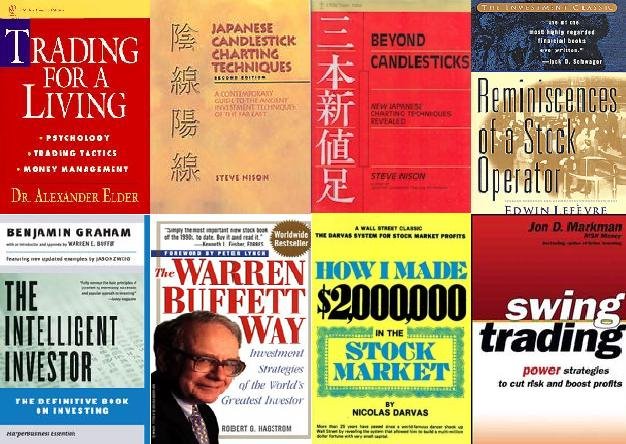
Dr Alexander Elder writes one of the best basic trading book covering from the right mindset, winning attitude, money management, and to essential technical knowledge.
Read all about it in Trading For a Living

After Trading For a Living, Dr Alexander Elder restrengthen and refortifies the principles to trading in Come to My Trading Room.

Maybe one still would have doubts. Perhaps Dr Alexander Elder is a genius. A rare exception. How could we mere mortals hope to emulate his successes? In the book, Study Guide to Entries and Exits, you will be shown to 16, yes 16 individuals who have different trading capitals base and levels of experience but are equally successful. They're all traders. :)

As usual, you are advised to download the ebook(s) soonest possible before the link expires or removed. I m not responsible of providing fresh links if they are no longer working.

Monday, April 23, 2007

Being Bold and Able to be Bold

In my previous post about Trading Plan - I stressed the importance of having a trading plan. A trading plan should have at the very least, three elements:
1) Entry position
2) Position sizing
3) Exit position

By having a trading plan, effectively, an individual has an added edge over the others. One would know what, when and how much to enter for a particular stock. The price is 0.50 now, should I enter now? The price is 0.49, is it now a bargain (since its cheaper than earlier 0.50) or does it render the plan null and void (since crucial support is broken)? I don't know, but your trading plan should already tell you that.

Ok, so we know whether we should enter or not. Question is how much? Should it be 1 lot? 5 lots? 10 lots? Should it be 5% of your funds, or 10% or 20%? Again, I don't know. Your trading plan should also tell you that.

Exit. Now comes the really difficult part. When to exit - irregardless of whether the exit is made on a profit or loss, when do we need to exit? If we purchased at 0.50, should we exit at 0.48 or 0.45? If the price moved to 0.60, should we take profit, or should we let it run?

Point is actually, when the market is ongoing, we barely have time to analyse or to think. Most of the work should have been done the day before. On the market day, we merely execute the plan - entry and exit should be planned. And when the time comes, we need to be bold to carry out the plan.

Say the plan calls for entry at 0.50, but we hesitate, the next moment, its going to be 0.52. Then, we ll tell ourselves, it ll pullback later, it will. But we re merely consoling ourselves. Price went up to 0.55. Should we still enter? Now its 0.05 or 10% higher than our original planned entry price. What do we do now?

Same with exit - whether its profit take level or stop loss - should we exit at 0.50 as planned? Heh, heh, I can tell you from experience, the moment we hesitate, the price is not going to go our way, its going for 0.48, the next moment we hesitate again, its going to be 0.45, and then 0.42 and lower and lower.

So be bold my friends. Be bold in taking and making the decision. And have the trading plan in hand - to be able to be bold.

"Boldness has genius, power, and magic in it. Begin it now."
- Johann Wolfgang Von Goethe

Saturday, April 21, 2007

Fear and Greed


Fear, fear is my ally
- Darth Maul


Fear is the path to the dark side. Fear leads to anger. Anger leads to hate. Hate leads to suffering. I sense much fear in you
- Master Yoda

Fear and Greed has always been blamed behind every market movement. When the movement is up, it is due to greed. When its a correction, it is fear. Many strategies have also been formed around these emotions - buy when everyone else is fearful, for example is a contrarian strategy.
There have been a lot of talks about the importance of having neither fear nor greed. Total emotionless in trading as emotions clouds our judgment. While this sounds logical, is this truly possible and would it yield a better result?


To know this for sure, today we look into Automated Trading System.
Automated Trading Systems automatically executes signals from any strategy through a broker. It is a software that trades your Trading System for you. Manual entry is no longer necessary. Entry and exit are made at lightning speed, so to speak.

Locally, unfortunately, there is no such software for or use and testing, or so none to the best of my knowledge. However, overseas wise, this development have been for quite some time.

The question remains, is consistent profits from an Automated Trading System possible?
According to a survey (poll) conducted by a leading trading forum, the results are as follows:
Yes - large consistent short term gains - 37%
Yes - slow long term gains - 11%
Possibly but none would sell their system - 24%
No - its a trader's fantasy - 28%

There could be other reasons such as the complexity of programming what the human mind knows into the software. Or some other reasons. However, from the results of the survey, we could see that among the traders, not many of them have generated profits consistently from these Automated Trading Systems.

Therefore, I am inclined to conclude that there exist no evidence that trading without any emotions would yield better results.

Courage is resistance to fear, mastery of fear, not absence of fear.
- Mark Twain

I used to have the fallacy that one should trade without any emotions. However, lately, thanks to Ben of Wisdom Wise, I realised that one need not be a robot to trade. One merely needs emotional control, not emotional absence. Make fear and greed an ally.

If you remembered, I ve posted an excerpt from Wall Street previously - Greed is Good.

Greed and fear - the notorious driver of the stock market.
Make them an ally.
To the end, we re only human.
Master your fear, master your greed, and have the wisdom to know when to be greedy and when to be fearful.

Friday, April 20, 2007

Ebook: Jesse Livermore


Jesse Livermore was touted as the World's Greatest Trader.
Why? Is it because of his successes in becoming the World's Richest Man from zilch?
Or from his successful bear raids?
Or cornering of many commodity markets?

Perhaps. But to me, the title was worthy but for a different reason.
Jesse Livermore was perhaps one of the earliest to lay down the rules of trading.
Never risk more than 20% of your capital.
Do not buy a stock because it has had a big decline from its previous high.
Profits always take care of themselves, but losses never do.
Never average losses.
Markets are never wrong —opinions often are.
And he did so with much glory and pain as well. His phenomenal rise and fall is all summarised and offers a great learning to us all. I believe it even paved the way to the emergence of Money Management Concepts.


Reminiscence of a Stock Operator


How To Trade Stocks


How To Trade Like Jesse Livermore


Legacy of Jesse Livermore

As usual, you are advised to download the ebook(s) soonest possible before the link expires or removed. I m not responsible of providing fresh links if they are no longer working.

Thursday, April 19, 2007

The HOLY GRAIL


In the ancient tombs of Pharaoh Tutankhamen of Egypt, it was said that there resides the Holy Grail for centuries. For centuries, many searched for this magical instruction on how to profit in the stock market but to date there has been no evidence of anyone succeeded in the quest. Rumor has it though that an elite few managed to unlock its secrets and earned vast fortunes from the market.

But beware! It is also rumored that the scroll of the Holy Grail is protected by the spirits of the Pharaoh’s himself! One wrong move, and the ancient spirits will descend a terrible curse on the unlucky one for seven generations.

This however, would merely mean nothing to the treasure hunters. Every year, new bands treasure hunters would emerge to embark a journey to seek this magical scroll of the Holy Grail.

Haha, thanks for indulging me with a little drama – just for humor J

Holy Grail, I m sure each and everyone of us, has at some point of our trading/investing lives, searched for this Holy Grail. And we would conclude that there are no such-a-thing as this rumored Holy Grail. And, oh, if you re still looking for it and have not given up hope on the Holy Grail, I must apologize for bursting your bubble. :P

However, allow me to share an excerpt from Van Tharp’s Trade Your Way to Financial Freedom, in which, I owe my gratitude to Mr CS Ong, I presume :)

The “Holy Grail” is not some magical source that is the key to the markets, as most people believe. The metaphor of the “Holy Grail,” according to scholars like Joseph Campbell, is all about finding yourself. Similarly, the “Holy Grail” in the markets - the key to unlocking profits - is all about finding yourself.

To unlock the “Holy Grail,” you need to appreciate your own ability to think and be unique. People make money by finding themselves, achieving their potential, and getting in tune with themselves so that they can follow the flow of the market.

Getting in tune with yourself means finding an inner peace inside. It means finding a balance between profits and losses. The Holy Grail is not a magical trading system; it is an inner struggle.

Once you’ve discovered that, and resolved the struggle, you can find a trading system that will work for you

Van Tharp couldn’t have said it better.

“If you look far, it’s very far away,
If you look near, it’s right before your very eyes”

- Chinese Proverb

Monday, April 16, 2007

EBooks: Nicholas Darvas


How I Made $2 Million in the Stock Market
Darvas Flow Chart

These ebooks are available for download in Blisswind Google Group.
And many more! Join today!
Hehe, good promotional gimmick, huh? But hey, it won't cost you anything :)

Sunday, April 15, 2007

GREED IS GOOD

Yeah, YouTube Mania has hit FusionTrader!!!


Cromwell:
Your company, ladies and gentlemen, is undersieged from Gordon Gekko! Teldar Paper is now leveraged to the hilt like some piss poor South American company. I strongly recommend you to see through Mr Gekko’s shameless intention here to strip this company and severely penalize the stockholders. I strongly recommend you to reject his tender by voting for management’s restructuring of the stock.

Gordon Gekko:
Well, I appreciate the opportunity you're giving me Mr. Cromwell as the single largest shareholder in Teldar Paper, to speak.
Well, ladies and gentlemen we're not here to indulge in fantasy but in political and economic reality.
America, America has become a second-rate power. Its trade deficit and its fiscal deficit are at nightmare proportions. Now, in the days of the free market when our country was a top industrial power, there was accountability to the stockholder.
The Carnegies, the Mellons, the men that built this great industrial empire, made sure of it because it was their money at stake. Today, management has no stake in the company!

All together, these men sitting up here own less than three percent of the company. And where does Mr. Cromwell put his million-dollar salary? Not in Teldar stock; he owns less than one percent. You own the company. That's right, you, the stockholder. And you are all being royally screwed over by these, these bureaucrats, with their luncheons, their hunting and fishing trips, their corporate jets and golden parachutes.


Cromwell:
This is an outrage! You're out of line Gekko!


Gordon Gekko:
Teldar Paper, Mr. Cromwell, Teldar Paper has 33 different vice presidents each earning over 200 thousand dollars a year.
Now, I have spent the last two months analyzing what all these guys do, and I still can't figure it out.
One thing I do know is that our paper company lost 110 million dollars last year, and I'll bet that half of that was spent in all the paperwork going back and forth between all these vice presidents.
The new law of evolution in corporate America seems to be survival of the unfittest. Well, in my book you either do it right or you get eliminated.

In the last seven deals that I've been involved with, there were 2.5 million stockholders who have made a pretax profit of 12 billion dollars.

Thank you.


I am not a destroyer of companies. I am a liberator of them!


The point is, ladies and gentleman, that greed, for lack of a better word, is good.
Greed is right, greed works.
Greed clarifies, cuts through, and captures the essence of the evolutionary spirit.
Greed, in all of its forms; greed for life, for money, for love, knowledge has marked the upward surge of mankind.
And greed, you mark my words, will not only save Teldar Paper, but that other malfunctioning corporation called the USA.

Thank you very much

Monday, March 26, 2007

Why I love the news


Never thought I am such a fan of news, heh?
Read on, let me illustrate with the following news from reputable publishing houses.
Its an observation made which has never cease to amuse me. :)

Dow Average, S&P 500 Advance as Higher Oil Lifts Energy Shares
March 22 (Bloomberg) -- The Dow Jones Industrial Average and Standard & Poor's 500 Index advanced for a fourth day as a surge in oil prices lifted energy companies.

I see, as oil prices go up, stocks will go up. OK. Got it.

Dow: 5-Day Rally, Back In Black
NEW YORK (CNNMoney.com) -- Stocks inched higher Friday, gaining after unexpected strength in home sales, but worries about rising oil prices limited gains.

OK, if there was no worries that oil prices may go up, stocks would have gained more. OK. Got it.
WAIT a minute... I thought, when oil prices go up, stocks will gain? But how come now oil prices' potential to go up, and stocks are limited from rising? Hey, something's not quite right here...

Well, hold on your horses. There's more :)

U.S. Stocks Rise on Employment, Wage Growth Data; GM Advances
Sept. 1 (Bloomberg) -- U.S. stocks rallied to four-month highs after the government said employers added more jobs and wage increases slowed last month, easing concern that higher interest rates would lead to an economic slump.
Ah, this rationale is simple - more jobs, means economy is good. And economy good, I suppose it means stocks will go up. OK. Got it.

U.S. Stocks Advance, Sending Dow Average to Third-Highest Close
May 5 (Bloomberg) -- U.S. stocks surged, sending the Dow Jones Industrial Average to its third-highest close ever as a smaller-than-forecast increase in the number of jobs last month eased inflation concerns
Ah, logical indeed. Lesser jobs, means economy not so good. Economy not so good, Federal Reserve (US' equivalent of Bank Negara) would not raise interest rate. And that means borrowing costs will not increase. So, stocks go up. OK. Got it.

WAIT a minute! Which is which now? So I know more jobs during good economy and less when bad economy. But good economy = stocks up right? Or bad economy = stocks up? Hmm, or did I even get the jobs as an indicator of the economy correct? :P

The human mind constantly look for reasons as to why things happen the way they do. It is our nature to find the reason. The journalists merely provided the justifications we so seek. Often with much logic in it that we cannot distinguish between what is real and what is not. It is said, "If you re looking for a bull, everything looks like a bull. If you re looking for a bear, everything looks like a bear." The human mind merely recognises the pattern which we so want to seek.

Stay objective. Don't believe everything you've read or heard. Stay objective.

Its not a race...


We often heard of how much one make. Or we often wonder how much does one make? Whether its trading, investment or a job, it makes no difference. Our KPC (keh poh chee) nature wants to know. And after knowing, we re not satisfied. And of all the things we learn from our neighbour, we learn kiasu-ism. Haha, my apologies to Singaporeans but you know its true :P.
We become impatient. We become uncontented. We become competitive. We commit another trading sin.

Trading or investment is not a race. There is no finish line. There is no competition between one individual and another. To me, it does not matter how much one make. Well done, congratulations, I d say. But the money remains the other person's. It would not be mine.
And what if I make less than the other person? Well, what does it matter to the other person? Its my gain, not his. Its my risk, not his.

In the book The Intelligent Investor by Benjamin Graham, the commentator, Jason Zweig said,
"To be an intelligent investor, you must also refuse to judge your financial success by how a bunch of total strangers are doing. You're not one penny poorer if someone in Dubuque or Dallas or Denver beats the S&P500 and you don't. No one's gravestone reads, "HE BEAT THE MARKET"
Good one. I could not refrain from chuckling no matter how many times I ve read this. And no, I don't have a clue where is Dubuque.

Also, it went on to say,
I once interviewed a group of retirees in Boca Raton, one of Florida's wealthiest retirement communities. I asked these people - mostly in their seventies - if they had beaten the market over their investing lives. Some said yes. Some said no; most weren't sure. Then one man said, "Who cares? All I know is, my investment earned enough for me to end up in Boca."

Could there be a more perfect answer? After all, the whole point of investing (or in our case, trading) is not to earn more money than average, but to earn enough to meet your own needs.
The best way to measure your investing success is not by whether you're beating the market but by whether you've put in place a financial plan and behavioural discipline that are likely to get you where you want to go. In the end, what matters isn't crossing the finish line before anybody else but just making sure that you do cross it.

And to be frank, I ve seen people who could make a million in 3 months. And I ve also seen the same person go bust in the next following 3 months. Its a mere risk and reward game. If you re willing to gamble, you could always plunge with all you have plus borrowed money, should you choose to. Few gains in a row, voila, a millionaire is made. Is that simple. But is that your style? You could lose everything and declare bankruptcy the next moment. Is that what you want?

So my friends, let us all take our own pace. Truly, the market is not a race.